Credit System
The credit system includes all processes related to the intermediation of loans. Also included in the credit system are all public and private institutions or companies that serve the supply of money and payment transactions. The credit system is strongly shaped by the Banking Act (Kreditwesengesetz). The Banking Act assigns BaFin (Federal Financial Supervisory Authority) the task of banking supervision. In doing so, the authority (BaFin) works very closely with the Deutsche Bundesbank and takes supervisory measures for banks.

Structure, Functions and Tasks of the Credit System
The structure of the credit system is divided into the so-called three-pillar structure:
- Public-law credit institutions (savings banks and state banks)
- Cooperative credit institutions
- Private credit institutions.
The credit system and the other elements are presented below.
The banking system is again divided into the Deutsche Bundesbank (central bank) and credit institutions. The Deutsche Bundesbank is Germany's central bank. The institutes are subdivided into various sectors - into commercial banks, savings banks, building societies and clearing centers.
Also included are credit cooperatives and cooperative central banks, mortgage banks, installment loan banks, transaction banks and credit institutions with special tasks.
Financial Services in the Credit System
Institutions offer a multitude of services in the credit system – so-called financial services. Financial services are offered by credit institutions, building societies, financial service institutes or insurance companies. The financial services offered include investment brokerage and investment advice.
An investment brokerage is a financial distribution channel that mediates insurance, financing and investment products between the financial service provider (insurance companies and banks) and primarily private customers.
Investment advice in the credit system is responsible for advising on an investment to be made in the future. Investments can be made, among other things, in shares, funds, the capital market or in real estate. A multilateral trading system also counts as a financial service.
The multilateral trading system is an exchange-like, internet-based network with the aim of bringing together providers and demanders on the financial market according to certain rules.
Requirements include the admission of trading participants, rules for price determination, control procedures and pre- and post-trade transparency by BaFin. The subject of the trading platform is the trading of securities.
Credit System: Issuance and Foreign Exchange Trading, Leasing and Pledging
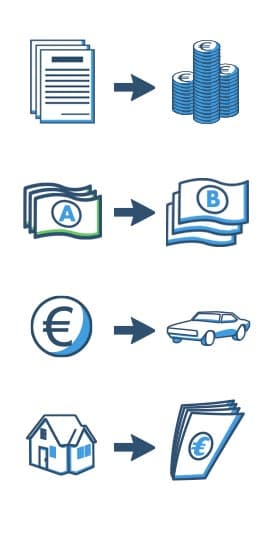
The placement business or issuance business in the credit system is a service in the area of financial services. An issuance is on the one hand the totality of securities of a certain type and category, and on the other hand the issue of new securities for the purpose of raising capital.
Securities are sold to investors via the stock exchange. Issuance is also the issuance of money as legal tender by the central bank.
Another financial service in the credit system is foreign exchange trading. Foreign exchange trading, also known as currency dealing, includes the purchase and sale of foreign currencies against domestic currency or against other foreign currencies. On the foreign exchange market, the spot and forward markets are distinguished.
Pledging is a financing secured by assets. Here, collateral securities for granting credit are used by credit institutions or banks. Collateral or pledged objects for lending can be items such as land, condominium ownership, but also movable items or rights (tangible collateral). Examples of tangible collateral (real security) are pledging, mortgage rights or transfer of title as security. A pledged object always refers to tangible collateral, but especially to real estate. It is not relevant whether the pledged object belongs to the borrower or a third party.
Leasing also plays an increasingly important role as a financial service in the credit system. Leasing is an atypical lease contract that involves the transfer of use. Leasing is used for movable (e.g. PC, copier, washing machines, etc.) and for immovable (e.g. factory halls) capital goods.
Basis for a leasing contract is the leasing contract. It contains the purchase price of the leased object, the residual value, the monthly lease payment, the length of the term, the effective interest rate, the contract start and contract end as well as one-off processing fees.
Installment Loans as a Component of the Credit System
An alternative to leasing in the credit system is the installment loan. Compared to an installment loan, leasing is the more expensive option. A central financial service is portfolio management or asset management. In contrast to investment advice, asset management involves the asset manager making investment decisions independently.
Asset management is applied in various asset classes such as stocks, real estate or bonds. Asset management is used for both private individuals and companies.
Distribution Channels and Accounts in the Credit System
There are three distribution channels in the credit system:
- stationary distribution,
- mobile distribution
- distribution via media.
The stationary operation is divided into full-service branches, standard branches, ATM branches and cooperations with retail companies. The mobile distribution in the credit system is divided into mobile branches, a bank-owned field service and independent credit brokers.
Distribution via media takes place via direct mail, telephone sales and home banking via the internet. The prevailing distribution channel in stationary distribution is still the branch.
Mobile distribution is characterized by the use of customer self-service devices. However, this carries the risk that personal contact between the credit institution and the customer is reduced.
Measures in the credit system to counter this problem are the increased use of customer advisors in branches as well as the establishment of a field service.
Overdraft Facility in the Credit System

The most important feature of the overdraft facility is the freely usable credit limit without a prescribed repayment period. The amount of an overdraft facility in the credit system ranges between 1 and 3 monthly salaries. The term is indefinite.
The overdraft facility is used for short-term cash needs. However, the interest rates of an overdraft facility range between 4.5 percent and 15.32 percent. The overdraft is repaid via incoming payments to the current account. Collateral is not required for an overdraft facility. An alternative to the overdraft facility is the simple installment loan with lower interest rates.
Loans from MAXDA: The Requirements
MAXDA is available to you as an intermediary service for loans and prepares individual offers for you. An installment loan can be granted by an institution in an amount from EUR 3,000 up to EUR 250,000. The term of an installment loan can range from 12 months up to 84 months (7 years). An installment loan is usually used to finance long-lasting consumer goods, such as cars or furniture.
The installment loan must be repaid in a fixed number of monthly installments. The monthly installments include the loan repayment, the interest and possibly the fees of the credit institution. Considered collateral for an installment loan are an assignment of wages and salaries, a guarantee or also a vehicle title. Good creditworthiness is advantageous for granting the loan in order to give the credit institution greater security. However, not only creditworthiness has a strong influence on the granting of credit. Regular income, collateral and also equity can make loan approval possible.

Mortgage Loan
Another form of credit is the mortgage loan. A mortgage loan is a loan used to finance the construction, purchase or renovation or modernization of a property. The mortgage loan is secured by mortgage rights on one or more properties. The amount of a mortgage loan can be unlimited, but loans of EUR 30,000 to EUR 300,000 are usually granted.
The term is between 5 and 30 years. Repayment of a mortgage loan takes place in constant monthly installments during the term. The granting of loans in the credit system is carried out by credit institutions, building societies and life insurance companies.
Construction Financing
A special form of credit in the credit system is construction financing. Construction financing is used to obtain funds and their use for construction projects. This includes capital market funds (loans from mortgage bond institutions, building societies, banks), employer loans, public funds and construction grants as well as equity.
It is used to cover the costs of the building plot (purchase and development costs) and construction costs. Advance loans, forward loans as well as pre- and interim financing are also counted as construction financing.