Leasing or Loan?
When financing personal desires, many people face the question of whether leasing or a loan is the more sensible and cheaper form of financing. Because the two financing methods differ in essential respects, the decision should be well considered.

Personal circumstances matter
Because both leasing and loans have their advantages and disadvantages, it is not possible to state in general which of the two options is the better form of financing. Rather, this depends on one’s own requirements and the planned purpose. With regard to the provision of capital and the conditions or financial outlay, both financing options show only marginal differences. A differentiation between loan and leasing can instead be made according to other aspects, for example how much capital is used and whether ownership of the financed object is to be acquired.
Distinction by definition
In fact, leasing is the renting of an economic good, such as a vehicle, in return for payment. This payment is made continuously in the form of the lease rate. A loan, on the other hand, is the provision of money for use, for which interest is usually charged.
Leasing and its pros and cons
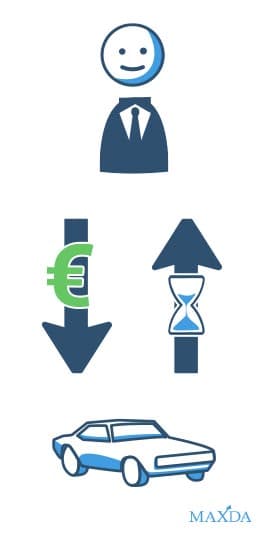
Undisputed advantages of leasing include the low monthly instalments, which can be reduced further with a down payment. These are in any case lower than with a loan. In this way, costly purchases can theoretically be realised at any time. Since leasing is a special form of renting, ownership of the financed object only transfers to the lessee after the contract term has expired. Typically, the term is between two and five years. After the lease contract expires, the leased item must be returned to the lessor. However, there is often the option to purchase the leased object at its residual value by paying in cash or arranging a follow-up financing. Usually this residual value is determined in advance and must not be undercut after the contract term. Otherwise, the lessee faces high additional charges. If the object is bought after the lease, the lessee often ends up paying more. In that case, a loan would have been the cheaper alternative. Leasing is commonly offered for vehicles such as cars. The car is leased for a certain period and the monthly payments cover the car’s depreciation. The lease term for a car is usually shorter than for a full car financing.
Advantages of leasing
- Because no loan needs to be taken out, liquidity and equity are preserved. Companies do not have to report debt in their profit determination;
- No securities (e.g. guarantee, asset, mortgage) are required. Accordingly, these are available for other financing purposes;
- Leasing provides a reliable basis for calculation, since the monthly rates are known at contract signing and remain unchanged even if interest rates move negatively;
- Depending on the arrangement, lease payments can be deducted immediately and fully as business expenses, thereby reducing tax burden;
- After the lease contract expires, the lessor bears the risk of disposal.
Disadvantages of leasing
- In most cases the total costs are higher than with a loan;
- Leasing does not confer ownership, so the item must be returned to the lessor at the end of the contract. However, a purchase option can often be agreed;
- The lessee is regularly obliged to maintain and service the leased object, such as a vehicle;
- While the lessor can terminate the contract under certain conditions, the lessee is obliged to fulfil the contract.
Loan and its pros and cons
With financing via a loan, where the item is paid off over an agreed period in fixed instalments plus interest, the borrower can already call the financed object their own after the first instalment. If the loan is used for a car purchase or car financing, dealer discounts for immediate cash payment of the car can offset the interest to some extent. Compared with leasing, the monthly instalments for a loan are significantly higher. To keep interest low, a short term should therefore be preferred if possible. A credit check is required for both loans and leasing. The advantages and disadvantages of a loan essentially correspond to those of leasing, but inverted.

Conclusion
Whether financing should be done by loan or leasing cannot be answered in general terms. If a line of credit is available and the monthly liquidity burden should be kept low, a loan is usually the better choice. If no line of credit is available or the item should not be transferred into one’s own ownership—for example to avoid the disposal risk—leasing may be appropriate. Leasing is a common form of financing, especially for vehicles. At the start, an individual situational analysis and a cost calculation for comparison should in any case be carried out.