
Directly to the topic:
In focus: high flexibility for the customer
At the end: three options to choose from
Follow-up financing through another installment loan
Possible reasons for using the return option
Three-way financing enables adjustment to changed life circumstances
The term three-way financing is used on the market to describe financing offers where borrowers can choose between different alternatives. It is increasingly offered in connection with car loans. Providers offer these products because they believe consumer expectations regarding financing the vehicle they want have risen steadily in recent years. A large portion of potential customers are therefore no longer reachable—or only with difficulty—by offers that are essentially based on a conventional installment loan combined with an additional down payment. In this respect, the three-way financing, sometimes also referred to as a three-way loan, represents an innovative financing model adapted to the development of customer needs.
Alternative terms for three-way financing include balloon financing or a loan with a final installment. The word "balloon" is used because the large final payment at the end of the term can sometimes be inflated like a balloon.
In focus: high flexibility for the customer
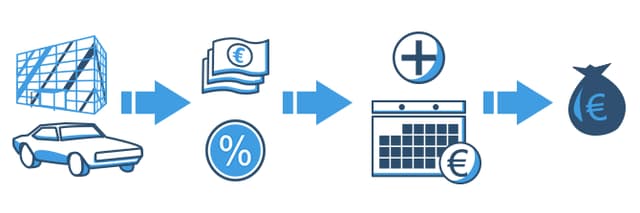
This form of car financing primarily focuses on flexibility. It aims to give the customer the option to finance the purchase of a car without having to commit to a single scenario from the outset. The acceptance of such financing solutions by customers shows that this is perceived as a genuine added value. In practice, providers typically design three-way financing according to the same basic principle. Usually, an initial down payment is required at the beginning, which depending on the price class and vehicle model is often in the range of 10 to 25 percent. This is followed by fixed regular installment payments over the agreed term. In this respect, the basic structure is comparable to conventional car financing. However, the monthly installments in three-way financing are significantly lower than in other installment loans, so the customer only bears a comparatively low regular burden of interest and principal. The decisive difference between three-way financing and other financing options, however, becomes apparent at the end.
At the end: three options to choose from
At the end of the agreed finance term, a larger final payment usually remains outstanding. With three-way financing, the customer has the option to choose between three different ways to settle this final payment. First, they can pay the outstanding amount in one lump sum at the end. If the customer chooses this option, the vehicle is fully paid for upon payment and immediate ownership transfers to the customer. This option is particularly suitable for borrowers who were able to build up additional liquidity during the term of the loan or who can quickly access a corresponding sum—for example because they inherited money, received a large bonus, or received a payout from a life insurance policy.
Follow-up financing through another installment loan
The second option within three-way financing is to convert the outstanding final payment into another installment loan, which is then repaid in monthly installments until the final payment is settled. If the customer chooses this variant, the three-way financing largely resembles a conventional installment loan for car financing, with the only difference being that the customer had the option during the term to decide how to settle the final payment. Once the second installment loan is also repaid, the borrower becomes the outright owner of the financed vehicle. The third variant, by contrast, provides that the customer does not have to settle the final payment at the end of the loan; instead, the car is returned to the dealer. In this case, the situation for the contracting parties afterward is very similar to vehicle leasing. The down payment and the ongoing installments paid until the vehicle is returned to the dealer are, in retrospect, nothing other than fees for the use of the vehicle, for which no ownership is acquired.
Possible reasons for using the return option
Compared with the other two variants, the last-mentioned option is often the most expensive, and at first glance it may seem contradictory to give up the car entirely after several years of financing when the acquisition was originally realized through financing. However, there are a number of situations in which this solution best meets the customer's needs. This applies, on the one hand, when the customer now intends to buy a newer vehicle model and no longer sees any point in continuing to finance what they consider an "outdated" vehicle. On the other hand, it is also possible that the customer no longer needs the car because another vehicle has been purchased in the family, the number of people in the household has decreased, or because they can no longer use the car for health reasons—to name just a few conceivable examples. In all these cases, it would be unsatisfactory for the customer to spend another large sum on the vehicle or to possibly remain tied to it for several more years through an installment loan.
Three-way financing enables adjustment to changed life circumstances
Against this background, the value of three-way financing lies primarily in sparing the borrower from having to commit to long-term financing from the outset. Instead, it allows the financing to be flexibly adapted to the development of individual needs and life circumstances or to the financial situation. That this choice is contractually guaranteed from the outset means a high degree of security for the customer, regardless of the flexibility gained, because they can rely on being able to choose between all three options in a few years' time. Thus, three-way financing is on the one hand a particularly customer-friendly and transparent financial product, and on the other hand it meets the desire of many customers not to commit themselves in the long term and not to take on long-term financial obligations. This strong preference among many customers has already led to shorter contract terms, flexible exchange options between different alternatives, or even prepaid models becoming increasingly important in other areas—such as telecommunications services. With three-way financing, this idea is now increasingly gaining ground in the field of car financing as well.