What is an overdraft credit?
An overdraft credit is always linked to a current account. The financial institution where the account holder holds the current account grants the overdraft credit. It serves as a limited overdraft facility. It is intended to bridge short-term liquidity shortages. The credit is available in full and does not have to be applied for. Repayment is possible at any time in part or in full. There are no installment payments for this form of credit.
General information about overdraft credit
What is the legal basis of an overdraft credit?
By legal definition, an overdraft credit is considered a loan. By contractual agreement with the account holder, the credit debit is enabled on the current account. No separate loan account is used. The credit limit is fully available to the borrower as long as the existing credit is not terminated.
Where does the term overdraft credit come from?
The loan is approved on what is known as a bank current account (Kontokorrent). This means that the credit is available to the account holder even when there is a positive balance in the account — i.e., when the account holder is in credit. As soon as the account moves into debit, the credit is automatically approved and the contractually agreed costs apply.
What is the difference between an overdraft credit and a "regular loan"?

Although both forms are loans, the contractual conditions differ. In a contract for an overdraft credit, for example, there are provisions for the maximum limit up to which the credit is available. A classic loan is approved as a one-time, fixed amount. Borrowers can use their overdraft credit at will up to the maximum limit. The maximum term, the interest rate, the purpose of the loan and the individual collateral are also contractually defined for an overdraft credit.
The financial institution expects its borrower to balance the current account within a billing period through turnover. This means that incoming funds must be sufficient to cover the credit in full. If there are repayment problems, the bank can completely freeze the affected account. In this case, the customer has no access to the account.
The overdraft credit also remains in place even after full repayment. A classic loan ends after repayment and cannot be used again. In that case a new application for a separate loan would be necessary.
Why is the interest rate on an overdraft credit higher than on loans?
Because the financial institution grants a standing credit on the current account that is available at any time without waiting, banks charge very high interest rates and processing fees. This is mainly because it is a convenient form of quick capital procurement that many customers rely on. Financial institutions charge well for this service.
Types of overdraft credit
An overdraft credit is named differently depending on its type. A main distinction is made between credits for private individuals and credits for business customers.
Overdraft facility (authorized overdraft)

The overdraft facility (Dispositionskredit) is granted to private individuals on a current account. The amount of this type of overdraft depends on various factors. The credit is not always automatically granted to new customers of a bank. Depending on the amount and regularity of income, it is often released by the bank after some time. If the overdraft is regularly used and properly repaid, automatic increases in the credit amount often occur. Repayment of an overdraft facility is often secured by the deposit of the monthly salary.
Note: Consumers face the risk of getting into a debt cycle. If the overdraft is covered at the beginning of the month by the salary, the financial basis for the rest of the month is weakened. This means it may be necessary to use the credit again. At the beginning of the next month the cycle starts again. This results in high interest rates for the overdraft, creating unnecessary additional costs. Consumers should make sure to use the overdraft only in absolute emergencies.
Working capital loan

A working capital loan (Betriebsmittelkredit) is issued to companies. This credit serves to cover classic liquidity shortages. In a company, for example, the overlap of payroll and incoming revenue is a known problem. Other overdraft credits for companies include:
- seasonal credit
- interim credit
- pre-financing
A seasonal credit enables companies to bridge seasonally caused shortages. This can apply to companies that produce Christmas items, for example. The interim credit is helpful when, for example, the payout conditions required for secured final financing are not yet met — because a portion of the goods is still in production, for instance. Through pre-financing, a company is supplied with capital to finance a project whose final financing is not yet secured.
How it works and terms for overdraft credit
Who can apply for an overdraft credit?
The financial product can be applied for by any adult legally capable person with regular income. Since the credit is always linked to a current account, it is usually necessary to provide proof of income.
In special cases, the account can also be opened for persons who do not have an income but can still demonstrate regular incoming payments — for example from an education fund.
Who offers an overdraft credit?

The classic route to an overdraft credit starts with the main bank and is requested for an existing current account. It is also possible, however, to open a new account with the corresponding credit. Current accounts are offered by almost all branch banks and direct banks. The accounts differ mainly in their cost structures for interest and fees.
A direct bank typically operates according to a fixed scheme. If the required prerequisites are not met, it is not possible to obtain the desired financial product. For private individuals, however, it is often possible to obtain a current account with an overdraft facility without much effort — provided there are no significant financial burdens.
Determination of the credit line
The so-called credit line is the contractually agreed maximum limit for the approved credit amount. If the borrower wishes to exceed the credit line, they must contact their bank. The financial institution is not obliged to approve an overdraft beyond the agreed credit line.

Special case — tolerated account overdraft
It can happen that a bank allows an overdraft beyond the credit line without prior consultation. If the bank grants this overdraft for more than three consecutive months, the amount is legally recognized as a new credit line for the account. It should be noted, however, that banks usually charge higher interest rates for credits outside the credit line.
Applying for the overdraft credit

The overdraft facility for private use does not necessarily have to be applied for separately. Some banks grant the credit automatically when the account is opened. Others work with a delayed approval that takes place a few months after the account is opened. Consumers have no entitlement to an overdraft on the current account. This applies especially when no regular income can be proven. The procedure is somewhat different for companies. Overdraft credits are approved individually depending on the company. It is important to be able to show the financial institution which form of credit is to be used. For this, the bank must be familiar with the company's specifications. The credit line is determined based on the company's specific financial data.
Termination of the overdraft credit

General credit provision is not tied to a specific period. As long as the credit is repaid within the due date, it remains in effect automatically. This means that it only ceases to be available if the current account is closed. The deadlines for the repayment of an overdraft credit are contractually defined. The exact details may vary slightly from provider to provider. However, as a rule it is expected that the credit will be fully covered within one month before it becomes available again.
If the overdraft credit is terminated by the borrower or the financial institution, this does not automatically mean that the account contract is canceled. The current account can still be used — but without the overdraft facility provided by the credit.
How high is the credit amount in an overdraft credit?
Is the credit amount for an overdraft always three months' salary? In the past, it was common for the overdraft credit to be issued for an amount equivalent to three months' salary. Today this looks different. A number of individual factors come into play. If the credit is granted automatically, the initial credit limit often starts at the amount of one month's salary. If consumers need a higher credit line, it can be renegotiated. For this the bank considers various aspects for private individuals:
- amount of income
- type of employment
- duration of employment
- are there collateral?
With a bit of negotiation, the limit can certainly be increased. However, caution is advised! The credit is very costly and can quickly lead the consumer into credit dependency, which represents a high financial burden.
What does an overdraft credit cost?

Which specific costs arise cannot be said in general terms. The costs consist of various variables. The most important cost factor is the interest rate. This is only charged when the credit is actually used. In addition, it is only charged on the amount drawn and not on the entire credit line. New banking models increasingly refrain from charging extra interest for an overdraft. In this case the interest calculation remains the same for the full drawn amount.
The mere provision of the credit does not cause costs. So if the credit is not used, the account holder does not have to pay for the credit.
Overdraft credit for companies, self-employed and freelancers
Are business accounts with overdraft credit a good choice?
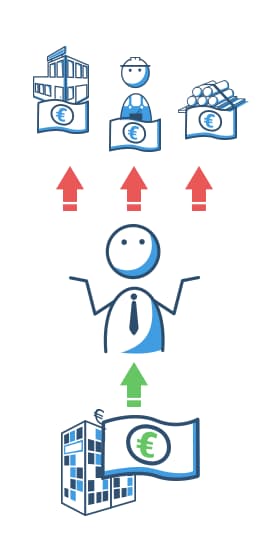
Companies and the self-employed know the problem of irregular liquidity. The reasons for this can vary. If, for example, the payment target for a large order is still far away, ongoing costs still have to be covered. In such a case, a business account with an overdraft credit greatly facilitates everyday operations. It is of course necessary that the credit line is set sufficiently high. The capital can be used in many areas:
- payroll
- supplier payments
- rents and leasing contracts
As advantageous as a business account with an overdraft credit is, it is often difficult to arrange. Banks frequently classify small companies and the self-employed in a high-risk category. If sufficient collateral cannot be demonstrated, it is likely that a credit will be denied. This problem especially affects start-ups that are unable to prove a financial history.
Opening a business account at a branch bank
In general, it is advisable to open a business account at a branch bank. This applies to companies of all sizes and to freelancers or self-employed persons who operate as sole proprietors. Although direct banks often tempt with low fees and interest rates, service can frequently be lacking in these cases. A dedicated contact person for business customers is worth its weight in gold at a branch bank. Individual requests can be discussed in detail. This makes it possible to obtain account management tailored to one's own requirements. Thus, even companies and business people with relatively simple finances can receive a suitable overdraft credit.
What collateral is required for the overdraft credit and loans for the self-employed?

Whether as a private individual or for a business account: granting credit typically requires collateral. The bank's first look is always at income. How high is it? Is it regular? The type of employment is also considered. A person in permanent employment is generally granted a higher credit limit than someone with a fixed-term contract.
Other forms of collateral can be recognized by the bank in many different ways. Home savings contracts, savings accounts or cash deposits are just a few examples. Finally, creditworthiness is also considered. For private individuals this can be in the form of a Schufa report. Banks can also examine past payment behavior on the existing current account. Are there frequent uncovered payment requests? Does the account usually remain in a good positive balance at the end of the month?
What constitutes good creditworthiness for companies with overdraft credit?

Determining creditworthiness for companies is a bit more complex. A Schufa inquiry also comes into play here. In addition, further factors are relevant:
- industry
- is it a seasonal business?
- company size
If a company has existed for decades and wants to move its existing business accounts to a new bank, account statements and financial books can be used to demonstrate creditworthiness. A company start-up makes this kind of check difficult. Therefore, it often depends on what initial capital is available for the business and what revenues can be expected.
Overdraft credit — advantages and disadvantages
An overdraft credit is a great solution for a financial emergency. If unexpected costs arise that need to be covered as quickly as possible, the credit is a simple solution. However, this high convenience is not cheap. High interest rates make the credit an expensive choice. Depending on whether the credit is used privately or for business, it has various advantages and disadvantages.
When is an overdraft credit sensible?

The big advantage of an overdraft credit is that it is available immediately. There are no waiting times that could lead to a financial bottleneck. So if unexpected expenses occur and a larger sum of money is needed at short notice, the overdraft credit is a simple option. Compared to a classic loan, however, the costs are extremely high. Interest rates are often in the double digits. The bank also expects the capital to be repaid within a short period. So if the sum of money is needed for a longer period, the overdraft credit is not the best choice.
When should you avoid the overdraft credit?
If the capital is to be spent on something that can easily be planned, it makes sense to resort to a credit alternative. This includes, of course, a classic installment loan. Some banks process applications within two weeks. A quick approval often provides the capital within three weeks. This applies equally to businesses and private customers. Especially for large amounts, this can save substantial costs.
Advantages and disadvantages at a glance
Private overdraft credit — Advantages
- Rapid availability in financial emergencies
- Credit line adjusted to individual capacity
- Available at any time after approval
Private overdraft credit — Disadvantages
- High costs due to interest structure
- Can lead to account freezing
Business overdraft credit — Advantages
- Industry-related liquidity gaps can be balanced
- Continuous ability to make payments ensured
- Loan approval tailored to the individual situation
Business overdraft credit — Disadvantages
- High cost structure
- Strict creditworthiness checks
What dangers does an overdraft credit pose?
It is easy to lose track of the actual costs of the credit. Many consumers do not know how high the monthly interest burden really is. It is advisable to study the pricing structure closely. This way hidden costs can be uncovered immediately.
Alternatives to overdraft credit
What alternatives are there to overdraft credit? Whether you are already in an expensive credit dependency or planning a new loan, an overdraft credit is rarely the best solution. Banks tend to keep interest rates for short-term loans very high. In recent years the interest costs for overdraft credits have continuously risen at all major banks. With a high credit line this can amount to several hundred euros per year.
If you want to use an alternative to the overdraft credit, you should definitely speak with your banking advisor. It is advantageous to work with a branch bank here. Although direct banks offer service hotlines, they are often not flexible. For business customers there are two relevant credit options suitable for bridging a short-term liquidity shortfall. Both alternatives are cheaper than the overdraft credit.
The demand loan as an alternative to overdraft credit

In principle, the demand loan (Abrufkredit) is very similar in structure to an overdraft credit. The account holder agrees an individual credit framework with the bank. The borrower is then able to move freely within this credit framework. However, it is set up so that a fixed repayment rate is agreed. The repayment rate is individually determined and tailored to the account holder's financial means. This usually results in interest repayment that is far below the typical interest for an overdraft credit. It is possible to replace an existing overdraft credit with a demand loan. For this the overdraft credit should preferably not be in use. However, this is not always a strict requirement.
Costs may arise again for replacing the existing overdraft credit. These should be clarified before replacement to avoid unpleasant surprises.
The Euro credit as an alternative to overdraft credit
Another form of business loan is the so-called Euro credit. It is, however, associated with strict requirements. Banks subject borrowers to a thorough examination. Very good creditworthiness is a prerequisite for approval. In addition, the classic Euro credit is usually only available from an amount of €50,000. In return, borrowers enjoy not only high flexibility but also a low interest rate.
Note:
Asking costs nothing! This also applies to the financial advisor. It is always possible to negotiate with the bank. Almost all financial products can be optimized according to the individual requirements of the borrowers. For a Euro credit this can mean, for example, that a lower loan amount is possible. For the demand loan the credit limit can be set individually.
Alternatives to overdraft credit for private customers

If a private customer plans to take out a loan, many options are available. Which type is best suited is determined by several factors:
- What is the capital for?
- What sum is needed?
- How should the loan be repaid?
Unfortunately for private customers, overdraft facilities are often the only quick way to obtain capital. Unplanned costs that need to be covered immediately are therefore often only manageable via an overdraft. Scenarios vary. Maybe there was a car accident and the vehicle is underinsured. To cover repair costs and make the vehicle roadworthy again, the capital is needed immediately. Maybe a relative died and there is no provision for the case; funeral costs and possible apartment clearances must be covered promptly. But if there is enough time to arrange finances, an installment loan is the best option for many. Consumers can individually adjust the loan amount, the repayment period and thus the total costs. A normal loan application requires a comprehensive credit check. This means students, unemployed people and pensioners often have difficulty getting approval. In this case an existing overdraft credit can be the best answer.
For goods such as furniture or electronic devices, more and more retailers offer financing. In the best case these are available at 0% interest. The buyer applies for the loan directly with the retailer; the bank is not involved.