Financing models for property
Most people need to take out a loan to buy a property. There are many different financing options when equity is not sufficient for the purchase. These should be examined carefully, because different financing models create different, usually monthly, costs for the borrower. The better the property buyer can obtain the financing loan, the better it is for them and the sooner they will be able to repay the loan. Not only the costs of the different financing models should be compared, but also the comparison of the different conditions is important. A good example of this are the special repayments, which are mentioned later in the text.

Private and commercial property purchase
When granting a loan for a property purchase, banks make a clear distinction between a commercial purchase of a property and a private house purchase. A private property purchase is considered financing that mainly provides the owner with living space. The purchase of the property, whether a house or a condominium, serves only personal use. This involves a completely different credit risk than a commercial property. For this reason, financing is handled differently. If a self-employed person or a freelancer acquires a property for personal use, this is considered private financing, since the property does not become part of the business assets.

Sources for property financing

Private property financing consists of a certain proportion of equity and debt financing through loan uptake from appropriate lending institutions. Equity here is made up of the borrower's savings or securities. Under certain circumstances, some personal contribution can be considered as a substitute for capital, which reduces the capital requirement for the loan. There are also certain state support measures that should be used for financing a property purchase by loan. These include the Arbeitnehmersparzulage and the so-called Wohnriester. The KfW-Bank (Kreditanstalt für Wiederaufbau) also grants funding under certain conditions.
Who is allowed to grant property loans?
Loans for the purchase of a property are provided by banks, savings banks, building societies, state development institutions, the KfW-Bank and also insurance companies. Not every lender is allowed to grant loans; they require an authorization as regulated by law for banking. In 2007, the total stock of loans for private individuals used for housing amounted to 791.6 billion euros. In 2007 alone, loans for the purchase of privately used properties worth 181.8 billion euros were granted. Occasionally, loans for private property purchases are also granted by private individuals, usually relatives, or by the employer in the form of an employee loan. However, there are strict limits for these alternative lenders. The granting of loans for property purchase is governed by the Kreditwesengesetz and the associated market. Loans granted for the purchase of a property may only be issued with a real property lien, which consists of an entry as a registered land charge. The property serves as collateral for the loan. Until the 1970s, financing of properties was almost exclusively provided by banks and building societies. Today banks grant around 75 percent of property loans, while the remaining 25 percent are provided by other lenders.

Internet loans for property financing
As part of the all-finance concept from the 1980s, insurance brokers can offer bank-like products. Since the 1990s, loan offers via the Internet have been added, because from the lenders' perspective the granting of loans for property financing is a business with a low risk of default, since the loan amount is secured by a land charge or a mortgage on the property.
If the proceeds are nevertheless too low to cover the outstanding debt in the event of a default, the property is usually sold at a foreclosure auction to recover the outstanding debt. A completely different risk arises when the contractually fixed interest period expires and the property price has changed. This is also called the fixed-interest period and determines the nominal interest rate for the entire term of the loan. If property prices fall, the value of the property also decreases, which may mean the loan is no longer sufficiently secured. If the lending value even falls below the remaining debt, the lender is entitled to demand additional collateral for the loan or to charge a higher risk premium.
If the two contracting parties cannot agree on a new arrangement, the lender can terminate the loan. However, the borrower is also entitled to negotiate with another lending institution about taking over the financing. If no alternative can be found, the lender may, after compliance with the legally prescribed deadlines, order a forced realization of the encumbered properties.
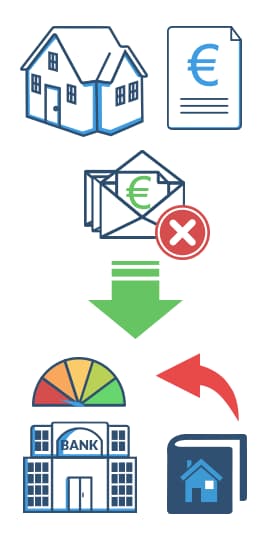
Normally, the loan for a privately used property is repaid over a fixed period of time, during which both interest and principal are serviced. This type of loan is called an annuity loan. The repayment portion immediately reduces the interest burden during the contract term. An annuity loan is granted only for the period needed to fully repay the loan. That is why it is also called a "full repayment loan."
In Germany, terms of 5, 10 or 15 years are common for the initial fixed-interest period. A short term for a property loan is rewarded with a low interest rate and the longer the term, the higher the interest rate selected. Under certain circumstances, suspension of repayment for a specified period can be agreed instead of the required repayment. In such cases, the borrower only services the interest due, while the principal amount remains unchanged because no repayment takes place. The repayment amounts are then paid into a repayment surrogate and treated there like a savings balance. At the end of the term it is used for the repayment of the loan amount. Repayment surrogates can also consist of claims from insurance benefits or income from fixed securities such as investment funds or life insurance policies.
However, special repayments can also be made. Before concluding a construction financing agreement, it should be carefully considered whether special repayments are possible and whether the chosen financing allows them. Therefore, it is worth comparing different conditions from various providers.
If the agreed fixed-interest period expires and a high outstanding debt remains while equity is still insufficient, a follow-up financing should be considered in order to continue repaying the outstanding debt monthly.
Building savings loans offer a different repayment option
Once a building savings loan is eligible for allocation, it takes on the character of an annuity loan. However, if the building savings contract is newly taken out to finance the purchase of a property, the building society usually provides pre-financing of the entire amount until the allocation from the contract occurs. In these cases, the usually monthly payments of the instalments for the repayment of the loan debt flow as savings into the building savings contract. The interest due is calculated on the entire pre-financed loan sum.
Buying a property is worthwhile mainly because it is seen as an increase in private wealth. Unfortunately, it also carries the risk of asset loss due to adverse circumstances. The development of the property market should therefore be monitored. For this reason, an interested buyer should always neutrally weigh the advantages and disadvantages of the purchase before buying. If the advantages outweigh the reasons for purchase, the property purchase is considered a worthwhile investment. Clear advantages include savings on rent and a potential increase in the property's value in the future. On the other hand, maintenance costs for the property, the costs of taking out the loan and a possible loss in value of the property must be offset.

There is no automatic increase in value when buying a property. Today, the location of the house or condominium largely determines the future development of its value. Properties in a desirable location can often see an increase in value, while properties in hard-to-sell locations are more likely to decline in value. Making the right decision when buying a house requires sound knowledge of the region's specific characteristics and its development prospects in the near and medium future. With a property purchase in a favorable location, higher returns can be achieved than, for example, with fixed-income securities. After all, the property market has shown a steady trend toward appreciation over the past three decades. When using a property as an investment, rental income must also be taken into account, as well as the tax exemption on capital gains in the case of an early resale of the property. Since gains from the sale of shares are often taxable, this is an advantage of buying a property as an investment. Most properties also offer some protection against loss of value due to inflation. If price increases are high and at the same time fewer property loans are taken out, a prospective property buyer can expect lower loan installments.