General information about instant money

If you want to take out a loan or credit to receive instant money, this simply means that you obtain external capital.
In the simplest case, you receive a loan from relatives or acquaintances. To avoid jeopardizing these relationships over money, you should agree on written terms before borrowing — just as you would with a bank's immediate payout.
However, only a few are fortunate enough to get money immediately through personal contacts. Maybe you also want to avoid having to ask around when borrowing money. In that case, using a loan broker like MAXDA gives you the opportunity not only to get money quickly but also at competitive conditions. A loan comparison via MAXDA offers a good alternative to expensive overdraft interest on your account and also enables immediate payouts even with Schufa.
The terms and conditions are agreed in advance between lender and borrower and fixed in writing. For a cash loan, the contract primarily specifies the exact loan term, the modalities regarding loan security and repayment, and, of course, the interest to be paid.
Once the loan application has been approved, nothing stands in the way of an immediate payout of a mini loan in the amount of 500 to 7,500 euros to your account.
Instant money as an annuity loan
The most commonly granted loan is the so-called annuity loan. The name refers to the form of repayment in which the charged interest and the actual principal repayment form the basis for the monthly instalment to be repaid. When taking out an annuity loan to receive instant money, the interest rate is fixed for a limited period. This period can extend over the entire term of the loan.
Due to this composition of instalments from a principal and interest portion, the interest portion decreases in favor of the principal portion as repayment progresses. A rule of thumb says that in the first year at least one percent of the outstanding loan amount should be applied as principal repayment. As instalments continue, the principal theoretically rises to 100 percent of the loan amount in the final year of the term. The annuity loan is one option for repaying a mini loan that is paid out immediately.
Repayment loan as a credit form for instant money
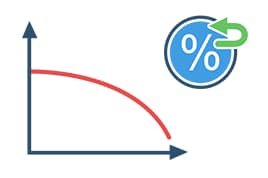
The repayment loan is another common loan type used to obtain instant money. A characteristic of this type of loan is that the scheduled principal repayment does not change over the years. At the same time, the interest amount to be paid decreases steadily with the monthly principal repayments. This form of loan amortization used to obtain instant money has the advantage that the first instalments consist only partly of interest payments. From the beginning, you pay a fixed sum back to the lender with a repayment loan.
However, the total monthly burdens — especially at the start — are usually higher compared to an annuity loan, because the interest burdens at the beginning of a repayment loan are relatively high. As the agreed term progresses, the interest burden decreases significantly.
Instant money through a bullet loan
Another frequently used option in practice to obtain instant money is the so-called bullet loan (also called maturity loan). This is a loan where the entire loan principal must be repaid at the end of the agreed term.
This repayment modality can be agreed by setting a limited term in the contract in advance, but it is often used when a loan has been terminated. In such a case, the finance and credit industry also speaks of a "making the loan bullet." During the "normal" term you usually only have to pay the interest that arises; whether the applicable interest rate is variable or fixed until the end of the term depends on the negotiations and conditions.
To secure the loan or as a kind of substitute for repayment, you are generally required to sign assignment declarations in favor of the lender, for example for claims from building society contracts, investment funds, private pension policies, or life insurance policies. Those insurance policies, funds, or contracts are then funded separately and the amount accumulated is used at the end of the loan term to repay the loan. An important component of the loan agreement is the specification of the minimum savings.
Instant money from MAXDA
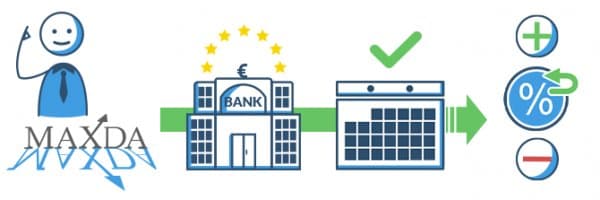
To have a fair and, above all, inexpensive loan brokered so that you receive instant money or the loan amount on your account promptly, you need a competent and reliable partner like MAXDA. Transparency throughout the process of application handling, loan selection and final immediate payout is a core competence of MAXDA.
As one of the largest and most established financial service providers in the private customer sector, we always place great importance on customer satisfaction. To ensure that you get the best possible terms for a loan to receive instant money, we work exclusively with leading and reputable credit banks from Germany and Europe.
Thus we are consistently able to offer you various loan types for instant money such as a mortgage loan or a consumer instalment loan on excellent terms. General-purpose loans for your personal use are available from us already from an amount of 500 euros up to 250,000 euros. In particular, mini loans are amounts that you can borrow from our partners without problems.
Loans for civil servants are also included in our range of services. However, certain requirements must be met to take out a civil servant loan. If you are a civil servant or an employee of the public sector — but also as an employee with at least ten years of service at your company — you can benefit from a civil servant loan that features particularly favourable interest conditions and long terms (up to 240 months).
Up to an amount of 5,000 euros you can even obtain loans from us without a Schufa entry, although you should factor in a processing time of about one week before you receive your money. The term "instant money" is therefore relative in this case.
Instant money: unbureaucratic speed of action at MAXDA
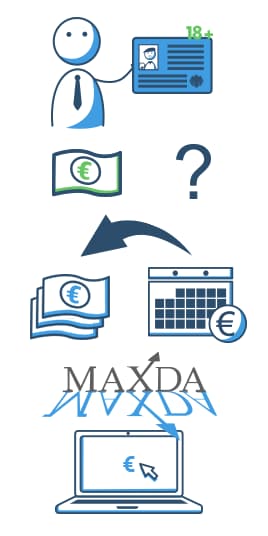
If you are at least 18 years old and earn at least 850 euros net per month, you already meet the basic requirements for successful placement of a loan to receive instant money. But even if you are currently looking for work and receive unemployment benefits or other social benefits, MAXDA can help. We have already been able to significantly improve the financial situation in many seemingly hopeless cases through our brokerage activities for instant money.
For the loans we broker to provide instant money, the effective annual interest rate starts at 3.99 percent for all terms. The interest rate agreed with us is fixed so that you always have a constant interest rate and can plan a fixed item in your budget.
Repayment of instant money
You can also determine the exact date of each repayment instalment (1st or 15th of the month); the first instalment is due for you four weeks after receipt of the full loan amount. We ensure an unbureaucratic and as speedy as possible handling of your request already at the time of your loan inquiry.
As soon as your loan inquiry for instant money reaches us, we inform you by email and by post about the documents we require to examine your loan request. Once the documents we ask for regarding payslips, rental income, pension notices or other proof of income plus the signed loan application have arrived at MAXDA, we guarantee that we will examine the submitted documents on the day of receipt.
If all requirements on your part are met, the way to a loan with premium conditions is open to you promptly. If you have questions or would like further information on how you can receive instant money, you can contact us at any time; during business hours we are available for you by email, telephone and of course also in person.
Fundamentals about money
The term money derives both from the Indo-European word for gold and from the Old High German word for value. Originally this term was associated with offerings, but from the 14th century the term was used for means of payment, especially coins.
Money is divided into two categories. On the one hand there is the material form and on the other hand the immaterial form. The material type mainly includes cash, i.e. banknotes and coins, while immaterial money mainly includes loans and bank deposits.
The type of money used in a country is called currency. First and foremost, money is a widely recognized and accepted means of exchange that can continuously be used. In addition, it is the subject of study in various disciplines such as economics, philosophy and sociology.
In everyday language and youth slang, synonyms for money have increased over the years. Terms like "taler" are enjoying renewed popularity.
The function of money
Money is defined in economics. It is primarily understood as a means of payment that simplifies the exchange of goods and preserves its value.
Money and its history
In the past many different materials such as gold, silver, but also shells were used as means of payment and thus as money. This money is called commodity money. Commodity money is characterized by being made either from natural goods such as grain (commodity money in kind) or from jewellery or gold and silver (jewellery money). Animals can also be used as a means of payment.
In the Middle Ages weight money was used. Here the weight of gold and silver was used as value. Especially in recent years discussions about the abolition of cash have increased.
Credit money
As history progressed, credit money became increasingly common. This was intended to satisfy the claims of another party. Today this form of money is widespread because every loan counts as credit money.
Until the beginning of the 20th century, the currencies of individual countries were usually defined by gold or silver standards. Prices were quoted in the respective amounts of gold or silver. Gold had a special status and was generally used to settle claims from abroad. During the 19th century, silver as a standard was replaced by gold.
Until the start of the First World War, there was a very good, stable currency relationship in Germany. As a result, there were hardly any exchange rate differences among the various forms of money. Exchange between countries was also extremely stable.
In the further course of the 20th century, the currency standards fell away. They were replaced by political measures intended to guarantee price stability, implemented by the respective central banks and still intended to do so today.
Money in the form of coins
Coin money was first used in the 7th century BC. Its introduction greatly facilitated trade. Coin money had the same form, the same weight and the same appearance. Instead of weighing, counting could be used. Due to this uniformity it was not subject to exchange rates or had to be converted into gold or silver values. Over the course of history, however, privately minted coin money sometimes enjoyed higher esteem than state coinage. The reason lay in the minting quality, which was higher for private coins and thus harder to counterfeit.
Paper money: the first banknotes
The first paper money arose in the 11th century in China. It was intended to be used as a substitute or representation when there was a shortage or bottleneck of coins. This first paper money can be understood as an IOU, since it required the holder to redeem the equivalent in coins.
Compared to China, paper money was not introduced in Europe until the late 15th century in Spain. The Netherlands, Sweden and France followed. In Germany banknotes were introduced as a means of payment only during the 19th century and accepted alongside coins. The value of paper money derived from the trust that it could be exchanged for coins at any time. Bills of exchange were also accepted to secure banknotes.
Today, with the euro in use, such coverages are no longer provided. Instead, the claims of the European Central Bank against other credit institutions are used as backing.
Money and the ECB
This works as follows: When a bank needs money from the ECB, the ECB — as with an ordinary private loan — requires sufficient collateral from the respective bank, the borrower. This collateral can include debt securities issued by the public sector, i.e. the state.
Compared to earlier procedures, the ECB is not obliged to exchange money for a fixed equivalent or a specified amount of silver or gold.
Paper money is inexpensive and easy to produce. It can be declared legal tender by a banknote monopoly such as that held by the ECB. If the issuance of paper money becomes too large, inflation occurs, meaning price increases and a loss of purchasing power. This mainly results from historical periods in which paper money was printed extensively to finance wars.
Bank money: cashless payments
Bank money (demand deposits) means the claim of a customer to payment from a bank. This term comes from the time when accounts were still kept in so-called account books. The balances on the accounts are called demand deposits. Demand deposits must be payable by the bank to the customer on demand.
Today, bank money is mostly managed electronically via IT systems and forms the basis of cashless payment transactions. Demand deposits arise in different ways. These can be cash deposits, the granting of loans, or electronic transfers. The holder of such a demand deposit can also make payments in these ways, i.e. transfer money to other accounts, withdraw or disburse cash, or issue checks.
Through the possibility of transfers, demand deposits have become a means of payment alongside cash. Unlike cash, bank money or demand deposits are not legal tender and therefore do not have to be accepted.
Electronic money
In addition to the previously known forms of money (coins, paper money and bank money), there is also electronic money today. This money is a type of bank money. This form is generally used for so-called money cards. These receive a specific value via data transfer that is then available to the holder for free use. Electronic money is merely a claim against the issuer in the specified amount; it does not constitute a credit. Credit cards do not belong to this type of money.