Installment payment
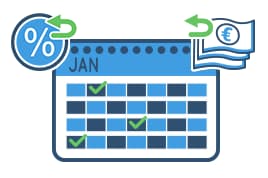
An installment payment means that the debtor pays the amount due not in a single sum but in several partial payments. Installment payments can be divided into deferments and installment purchases; the decisive factor is the point in time at which the installment agreement is concluded. This applies in contract law; in tax law the terms deferment and installment payment are defined differently.
The tax office places high demands on the granting of a deferment, but if it rejects it can approve an installment payment instead, allowing the taxpayer to achieve the hoped-for outcome. The partial payments to be made are referred to as installments in both deferments and installment purchases. Usually each installment is of equal amount, although a differing initial or final installment may serve rounding purposes. Deviations such as a large down payment or a substantial final installment are possible. Freedom of contract also allows the agreement of installment plans with amounts varying depending on the payment date; in practice this variant occurs more often with deferments than with installment purchases.

Deferment

Originally, deferment denotes the situation in which creditor and debtor agree to postpone the due date of a payment. This can concern the entire claim or partial amounts. From this developed a further meaning, so that a deferment can also denote an installment payment that the contracting parties agree only after receiving an invoice or payment reminder. Deferment is usually based on an application by the debtor. When someone is sentenced to a fine or ordered to pay damages or compensation for pain and suffering, the judge can also offer installment payments in the judgment. Common reasons for deferments are unexpectedly high electricity and gas bills.

Many energy suppliers are willing at the customer's request to allow installment payments of up to six monthly installments on annual bills, for which large suppliers often charge no interest. However, they refuse installment payments if payments have repeatedly been received late during the billing period. That a deferment is agreed after a purchase may come as a surprise, since in that case it might seem more sensible to conclude an installment purchase directly. However, dentists and clinics often inform their patients that the copayments to be made are collected via a billing service provider, and that this provider offers an installment payment from a certain amount. Since this is only bindingly agreed after receipt of the invoice, it is legally a deferment, even if the patient already stated at the time of the contract that they wished to pay the invoice in installments.
Installment purchase

The second case of an installment agreement concerns the installment purchase. Other terms are purchase on installments, part payment or part-payment purchase, or finance purchase, whereby the last term is ambiguous and is also used for the mediation of an installment loan by the retailer.
The distinction between an installment payment at the retailer and an installment loan is that in an agreed installment payment the customer transfers the individual amounts (monthly installments) directly to the retailer, whereas if an installment loan is additionally taken out the repayments are made to a bank.
Thus the buyer has a single contractual partner for both the purchase and the financing in an installment payment. The retailer refinances the installment payments it has approved through a bank and, due to the costs incurred, usually has to charge interest (a surcharge). This results in a surcharge that is dynamically composed depending on the number of monthly installments and the purchase price. How a surcharge is composed is explained in the excursus below. \

Some mail-order companies and specialist electronics stores offer interest-free installment payments; in such cases the retailer has already factored the interest costs incurred into the purchase prices. (However, an annual percentage rate is usually indicated.) A credit check is performed before concluding an installment purchase contract. With existing customers—customers who have ordered/purchased before—most retailers use the credit data from previous business relationships and assume that customers who have paid punctually in the past will also pay the agreed installments (usually monthly installments) on time during the term.

With first-time buyers, mail-order retailers carry out a Schufa inquiry and additionally require a down payment for larger sums (purchase prices). The one-time payment at the start of the contract not only reduces the debt amount and the default risk, but also serves as an indicator of the buyer's creditworthiness. If a retailer rejects the requested installment payment, the purchase contract does not come into effect unless the customer agrees to the suggested immediate payment of the purchase price. In addition to installment payments, large mail-order companies regularly offer a payment holiday. This means that the first installment is not due until after a few months.
Excursus: How is the surcharge calculated?
Some mail-order companies offer the option of an installment purchase. A so-called surcharge (or mark-up) arises for the buyer. The surcharges depend on the number of monthly installments as well as on the purchase price. An exemplary sample calculation for surcharges is offered by mail-order companies such as Otto or Quelle. There a surcharge on the original purchase price is calculated as: purchase price x monthly surcharge Y number of monthly installments : 100 = buyer's surcharge. The monthly surcharges are listed in a surcharge table at the retailer. Vouchers are often offered in connection with installment purchases by mail-order houses. In any case, check your finances carefully—a voucher is of no use if you cannot meet the payment deadlines. Before ordering, you should check your household finances.
Advantages and disadvantages of installment payments

When consumers receive unexpectedly high bills, the subsequent arrangement of an installment payment gives them the option of paying them without taking out an external loan. Unexpectedly high electricity bills often occur after a new family member arrives, since hardly anyone thinks about the fact that electricity consumption depends on the number of household members and that babies count too—baby laundry consumes electricity. Installment payments are also helpful when urgently needed household appliances (with high purchase prices) must be purchased. Saving up for a washing machine is not possible in the event of a sudden breakdown of the old appliance, since using a laundromat as a substitute involves considerable additional costs and a large time expenditure. Thus installment payments are fundamentally a sensible measure for urgently needed purchases. In contrast to installment loans, however, the retailer usually only carries out a limited creditworthiness check of the customer.
If patients do not know that the dental billing office will grant them an installment payment, they forgo medically or cosmetically necessary dental prostheses. Installment payments via retailers are easy to obtain. While a credit institution receives data on existing liabilities in a Schufa inquiry, Schufa only informs a retailer about existing negative entries and the stored address data.
This makes it possible to conclude several contracts for installment purchases. For the consumer it is initially advantageous to be able to agree an installment payment with a retailer despite existing liabilities. This also applies with a low income, because requesting an income statement is largely uncommon in mail-order business. Stationary retailers such as electronics stores and consumer markets also only request proof of income for larger purchase amounts; in other cases proof of an existing bank account at a bank is sufficient.
The easy availability of part payments means that these contribute to consumer insolvencies far more frequently than installment loans. Consumers are particularly required to check for themselves before agreeing to an installment payment whether they can actually pay the installments on time, since retailers generally do not perform the standard bank household calculation before granting credit. So check all income and expenses on your account to realistically assess whether you can ensure the installment payments. Only then does financing in installments make sense.
The credit card installment feature

A special form of installment payment is offered by the credit card with an installment feature. Here the cardholder pays the issuer of the credit card monthly either the minimum amount or any higher amount of their choice, while the retailer receives the total amount (purchase price) from the credit card company in a single sum. The option to choose installment repayment is available with most credit cards, but every consumer should carefully calculate the usefulness of this feature beforehand.
Submit a non-binding inquiry to MAXDA now — your reliable loan broker on the internet!