Inflation – price increases under the microscope
The term inflation comes from Latin and roughly means swelling or puffing up. In economics, inflation refers to a general rise in prices with a direct loss of purchasing power. To keep the loss of purchasing power within limits, the Bundesbank used to be responsible for maintaining price stability. Today, the European Central Bank (ECB) has this task and aims to keep the inflation rate in the medium term at a maximum of 2%.

Measuring inflation – how are inflation rates created?
To make inflation measurable, i.e. to express it in numbers, the consumer price index is usually used as the basis. The consumer price index in Germany is based on a "basket of goods". This basket represents the consumption of an average household (approx. 2.3 persons) in a specific year, the so-called base year, and is therefore considered representative.
For this purpose, the Federal Statistical Office now applies the hedonic formula to some product groups such as IT products. This formula takes significant quality improvements of goods into account, as is common in the IT sector. As a result, significantly lower inflation rates can be determined than the actual value of the same standard of living. However, this calculation method is criticized because some factors, such as reductions in product quality, are not captured by it.
Another method alongside the hedonic formula is the COLI index (Cost Of Living Index). This approach considers the actual expenses required to achieve a certain standard of living.
What is the significance of the basket?

Using this basket and the chosen base year, the cost of living for each year is recorded. By comparing the consumer prices, percentage changes to the previous year or to the base year can then be calculated. However, it must be noted that the longer or older the basket becomes, the less representative it may be, since consumer behavior changes over time.
This change is mainly because expensive products are often replaced by cheaper ones or product innovations are offered on the market that replace other products. Also, real estate and financial markets are not considered in this basket. This means that price increases in areas such as hedge funds can expand the existing money supply and thus raise the price level, but this is not reflected in the index.
How are the individual product groups weighted in the basket?
Since consumers in Germany spend different amounts on different areas of life, the statistical basket for the consumer price index weights the product groups. Based on the 2010 basket, this looks as follows:
| Product group | Weighting |
|---|---|
| Food and non-alcoholic beverages | 10.27% |
| Alcoholic beverages and tobacco | 3.76% |
| Clothing and footwear | 4.49% |
| Housing, water, electricity, gas and other fuels | 31.73% |
| Furniture, lighting, appliances and household goods | 4.98% |
| Health care | 4.44% |
| Transport | 13.47% |
| Communication | 3.01% |
| Recreation, entertainment and culture | 11.49% |
| Education | 0.88% |
| Accommodation and food services | 4.47% |
Table 1: Weighting for the basket used to determine price increases in the consumer price index, base year = 2010, Source: Federal Statistical Office
\
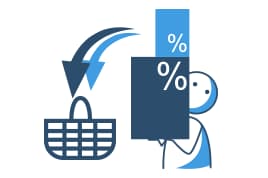
The weighting of the different consumer prices is very important for the inflation rate and the perceived inflation. For example, if food prices rose by 20 percent in one month, this would only mean an increase in the overall inflation rate of 2 percent in that month. Of course, this only applies under the assumption that nothing else changes. Nevertheless, it would be disastrous for you as a consumer if you suddenly had to spend €480 per month on food instead of €400 as before, while the statistics for Germany still looked relatively calm in terms of inflation.

Perceived inflation – when statistics reach their limits
In addition to these calculated and actual inflations, there is also the so-called perceived inflation, which stems from the fact that everyone experiences the extent of inflation differently. The reason for this is the differing importance between the goods in the basket and consumer goods such as cars and everyday necessities.
A consumer notices price increases for everyday goods more markedly than for durable consumer goods, which are included in the index measurement but play no practical role for the consumer due to their rarity.
Types of inflation and their consequences
Originally, inflation referred to the exorbitantly rapid price increase at the beginning of the 1920s. Today the term describes the rise of the price level in a country regardless of the speed at which it occurs. The term inflation is divided into two subtypes: mild inflation and severe inflation.
Mild inflation
With mild inflation, the loss of purchasing power is up to about five percent per year. This situation can also be considered standard in the economy, since price increases of up to 2% are even desired by the ECB. They stimulate demand because consumers want to spend their money on consumption or investments. For investments, this only applies as long as returns (e.g. interest or dividends) are significantly above the inflation rate.
Severe inflation
With severe inflation, the loss of value is more than five percent. Here, money loses its value faster than other assets and goods, and such goods can be used as substitute currencies.
These substitute currencies can be other national currencies, such as the US dollar in Argentina at times, or other goods, like cigarettes in Germany in the period after World War II. Furthermore, capital flight can occur. That means capital is withdrawn from the market, transferred abroad, or invested in other assets.
Severe inflation also leads investors to withdraw their capital from the capital market, which in turn causes interest rates to rise. Companies may eventually be unable to pay interest and, if liquidity is insufficient, may have to file for insolvency. Such a situation would have immense effects on the economy. In severe inflation there are hardly any winners.
One exception is the state, because its national debt decreases and tax revenues can increase significantly due to bracket creep. The velocity of money in circulation also increases. Because of the constant devaluation, no one wants to hold money for long and people try to obtain an appropriate countervalue as quickly as possible. If there is a shortage of real goods, money is invested in foreign currencies (foreign exchange), which accelerates the loss of value.
Examples of severe inflation

In the aftermath of severe inflation, currency reforms are often carried out. When inflation causes a loss of value of 50 percent per month, it is called hyperinflation. But even these cannot be sustained for long, because here the value of the paper can exceed the bank value. This can be illustrated by the example of the price of an egg in Germany in 1923. While the price in 1912 was seven pfennigs, at the beginning of August 1923 it was 923 Papiermark, three weeks later 177,500 Papiermark and three months later even 320 million Papiermark.
History provides plenty of other examples of severe inflation. Notable cases include the price revolution in Europe during the 16th century, the Thirty Years' War, and revolutionary France. More recently, the inflation of the 1920s stands out, as well as Germany during the Second World War, Argentina and Brazil for decades up to the 1990s, Mexico, and Southeast Asia in the mid-1990s. In addition, the oil crises of 1973 and 1979 produced high inflation rates, although not all goods were affected equally by the price increases.

How inflation develops
In addition to economic factors, government measures can also influence inflation. This usually occurs when the state wants to take over or influence the regulation of free price formation. Instead of open inflation, one then finds hidden or suppressed inflation. Signs of these types of inflation include long queues in stores or the emergence and flourishing of black markets.
Reasons and causes of inflation
The inflation rate can be strongly influenced by various factors that must be considered independently of economic conditions. These factors include wage increases, price increases resulting from government actions, and also tax increases.
Imported inflation must also be taken into account. Imported inflation refers to a situation in which inflation occurring abroad is transmitted to the domestic country. Hedging against this is relatively easy with fluctuating exchange rates of the respective currencies. It is different, however, if a fixed exchange rate between the two currencies exists. In that case, inflation would be immediately transferred to the domestic country.
Demand-pull inflation
Demand-pull inflation is a general rise in the prices of goods and services caused by demand effects. Simply put, demand for goods and services rises so strongly that suppliers cannot expand their capacities quickly enough. As a result, they raise prices because consumers are willing to satisfy their consumption wishes at higher prices. Demand-pull inflation can come from different areas:
- Consumer inflation
Consumers increase their demand for consumption and supply cannot keep up quickly enough to meet the increased demand. This leads to higher prices for goods and services. - Investment inflation
Investment inflation is a direct consequence of consumer inflation. Companies build new capacities and increase demand for investment goods. This rise in demand pushes prices up again, leading to a higher rate of inflation. - Government demand inflation
In this form of demand-pull inflation, government demand for goods and services increases. Because an increase in government demand often reaches a level that is relevant to the economy, it can also trigger a general rise in prices. - Imported demand inflation
Countries with high export surpluses often face situations where inflation rates abroad are generally higher. This leads to lower prices at home. However, if demand from abroad becomes too strong, domestic capacity limits can be reached, which can also lead to inflation at home.
Supply-side inflation
Supply-side inflation refers to a price increase whose cause lies in the actions of suppliers of goods and services. In this context, two different types of supply-side inflation are distinguished:
- Cost-push inflation
Cost-push inflation arises whenever suppliers of products and services must raise prices due to rising costs in order to maintain profit margins. The reasons for cost increases can be diverse:
\- Wage increases above productivity growth\
- Increases in non-wage labor costs (social security contributions)\
- Increases in raw material costs (imported supply-side inflation)\
- Increases in the costs of intermediate goods
In this case suppliers pass the price increase on to consumers so that profit margins are not reduced.
- Profit inflation\
Profit inflation occurs when companies exploit their market power and increase their profit margins despite unchanged cost conditions. This is only effective if the market in question is a monopoly or an oligopoly. Otherwise, a company's price increases would cause consumers to switch their purchases to other providers. In effectively functioning markets, profit inflation is therefore rather rare.

Influencing inflation through politics and the economy
Politics and the European Central Bank (central bank) have various means at their disposal to influence the rate of inflation. So if you are annoyed by high prices, this can also be a consequence of monetary policy. The most important measures are outlined below so that you, as a consumer, can get an idea:
- Interest rate policy as a control lever for inflation (ECB)
The ECB's task is to keep inflation in the long term at around 2% per year. It can achieve this, among other things, by controlling the amount of money in circulation. The most important lever here is the refinancing rate for banks.
\
Only the ECB is authorized within the EU to introduce new money into circulation. It does this via loans it grants to commercial banks. Banks borrow money from the ECB to grant loans or make other investments. Because this money was not previously in circulation, the money supply and money available increase. If there is no corresponding demand (e.g. for loans), the value of money decreases, which manifests itself as inflation. Commercial banks must pay interest for the money borrowed from the ECB, the level of which is defined by the ECB's refinancing rate. If general price increases are too high, the central bank raises the refinancing rate. This, of course, has consequences:
a) Commercial banks must pay more for new money. They charge higher interest rates for loans to companies and private individuals. Higher loan interest rates reduce the demand for loans (any potential investment inflation is dampened).
b) Commercial banks also pay private savers higher interest rates for their savings in order to attract fresh capital. People's propensity to save increases. Consumption falls and any consumer-driven inflation weakens.
\

Of course, the mechanism also works the other way round. This is often practiced to stimulate economic growth. When interest rates are low, consumers spend more, which in turn leads to higher revenues for companies. As companies expand their capacities, investments rise and unemployment may fall under certain circumstances. It is important, however, that the resulting price increases remain manageable.
2. Minimum reserve policy (ECB)
The ECB can also require commercial banks to hold a certain share of their deposits (demand deposits, time deposits and savings deposits) with the ECB as a reserve. The money tied up in this way is not available to the banks for lending, which limits the amount of money in circulation and thus dampens the inflation rate.
3. Open market operations with securities (ECB)
Another instrument for creating central bank money is the temporary or permanent purchase of securities from commercial banks. They receive a credit balance in return, which they can use again for their banking business.
4. Reduction of government spending (State)
By cutting its consumption expenditures, the state can also help to moderate the rate of inflation. Consumption expenditures here include subsidies or spending on public employees, for example.
5. Tax changes (State)
Changes to a country's tax system always affect consumption, investment and saving behavior. Higher consumption taxes (e.g. value-added tax or fuel tax) cause consumers to reduce their consumption. Higher income taxes can also lead to less consumption because consumers have less money available. Besides cooling the economy and possibly increasing unemployment, this also acts to curb inflation.
The presentation of factors influencing inflation is not exhaustive, as there are many other ways in which the state can affect the rate of inflation. Unfortunately, these can sometimes lead to misdevelopments that consumers like you may suffer from.

What is the difference between inflation and deflation?
The concept of inflation is inseparably linked to deflation. Deflation means exactly the opposite and includes general and sustained price decreases, which increase the value of money. What may seem positive at first glance can, however, lead to considerable problems in an economy:
- Falling demand leads to falling prices: If demand for goods and services generally falls, prices naturally also fall (companies reduce prices to stimulate demand). This leads to lower corporate profits and reduced investment activity. The long-term consequence is lower economic growth, which in turn leads to higher unemployment.
- Companies engage in ruinous price wars: A ruinous price war occurs when companies continuously undercut each other with special offers and discounts. Eventually the economic basis is exhausted and market participants have to file for insolvency.
- Consumers postpone purchases: If prices continue to fall steadily, consumers delay major purchases. They expect prices to fall further. The result: overall consumption declines and the economy grows even more slowly – the feared stagnation with deflation (stagflation is sometimes used to describe deflation with economic stagnation, though strictly stagflation historically refers to inflation plus stagnation).
What is cold progression?

Cold progression is a phenomenon in German tax law that occurs in connection with price increases. It refers to the fact that a small salary increase can be eaten up by the higher progressive tax rate. Inflation additionally causes you as a taxpayer to have less purchasing power at the end despite a salary increase. This mainly affects people with middle incomes. A small fictitious example illustrates this:
| Item | Amount |
|---|---|
| Inflation rate | 1.5% |
| Wage increase | 1.5% |
| Taxable income (before wage increase - single person) | 30,000 Euro |
| Income tax | 5,348 Euro |
| Net annual salary | 24,652 Euro |
| Taxable income (after wage increase - single person) | 30,450 Euro |
| Income tax | 5,488 Euro |
| Net annual salary | 24,962 Euro |
| Purchasing power after deducting inflation | 24,587.54 Euro |
| Loss of purchasing power | -0.261% |
Table 2: Example of cold progression
Cold progression thus has the consequence that despite a wage increase equal to inflation, you suffer a loss of purchasing power at the end due to the higher tax burden.
How can you protect yourself from inflation?
Protection against inflation is a deeply rooted desire in Germany, stemming from the hyperinflation of the 1920s. If you want to protect yourself from inflation, you have several options, although on their own they only help to a limited extent:
- Investment in gold: Gold and other real assets are tangible and therefore have an inherent value. In a major crisis they could serve as a medium of exchange. However, investing your entire fortune in gold entails risks. The gold price is driven by speculation, so you could lose a lot of money. A small gold allocation in a diversified portfolio does, however, offer some protection against inflation.
- Investment in real estate: Real estate also has intrinsic value, but price developments strongly depend on local demand. While property prices in big cities have been rising for years, they tend to stagnate in rural areas when inflation is taken into account. Owning your own home can still offer protection because you are not subject to continuous rent increases during inflation.
It may also make sense to finance certain purchases by taking out a loan. Price increases mean that debts become less valuable in real terms, so the real burden decreases. Of course, overdoing this is more harmful than helpful. Unfortunately, there is no definitive protection against severe inflation, although the measures presented here can provide a certain basic level of protection.