What is identity verification?
Identity verification is a procedure to determine a person's identity. This type of identity confirmation is used particularly often by banks, financial service providers or online retailers before entering into business with a prospective customer. To confirm the truthfulness of the information provided, an identity verification is carried out before, for example, a purchase on account is approved or a loan is granted. Especially for online banks, this is a very important process as part of their own protection against fraud and unnecessary bureaucratic effort. In this guide we explain all variants of identity verification and their areas of application.
When is identity verification required?
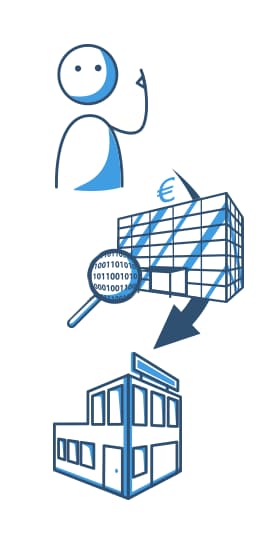
Identity verification is always required when a customer wants to conduct financial transactions through a bank. The person must prove that all required documents have been issued and signed in the real name. This allows banks to verify that the person is indeed the one who wishes to enter into a contract with the credit institution.
Identity verification is required in the following cases:
- Opening an account
- Applying for a loan
- Opening a securities account (depot)
- Renting a safe deposit box
Opening an account: When opening an account, the identity procedure must establish whether the identity documents are genuine and match the new customer.
Applying for a loan: If a customer wants to apply for a loan from a bank, they must verify their identity during the application process. This confirms their identity again and the process can continue.
Opening a securities account (depot): If a securities depot is to be opened at a bank, the customer must also prove their identity. They buy shares and trade on the stock exchange, and assets are transferred in the course of these transactions. For this, identity is mandatory.
Opening a safe deposit box: When opening a safe deposit box, the identity procedure also comes into play. After all, the bank customer could place illegal items in the safe deposit box, so the customer's identity must generally be known and proven.
How is identity verification performed?
Identity verification can be carried out in different ways. The most common methods include:
- Verification using identity documents
- Verification via the PostIdent procedure
- Verification via online identity verification
Identity documents: When opening a checking account at a local branch, the usual identity documents are completely sufficient. With an identity card, passport or an appropriate registration certificate, the applicant can prove their identity and open the account at the bank. The bank employee checks the passport, identity card or the relevant registration document for validity and authenticity. He compares the photo with the applicant present. If all information matches and the identity document is valid, the desired contract with the bank can be concluded.
PostIdent procedure: The PostIdent procedure is always used when the credit institution is not near the applicant, or, as is often the case with many online and direct banks, does not have a branch network. The PostIdent procedure was developed specifically for direct banks. The process is relatively simple. The bank provides the prospective customer with a corresponding form. The customer must fill out this form and take it together with their identity documents to the nearest post office. The post employee then assumes the bank's role of verifying the customer's identity and identity documents. If everything is in order, he certifies this with his signature and a stamp on the bank's form. This is then sent directly to the bank to prevent further manipulation. In this way, the customer's identity can be verified within a short time.
Online verification: Online verification is becoming increasingly popular. Many banks use it because it further shortens the time until the conclusion of a financial contract. Online verification is actually an umbrella term, as many smaller procedures fall under it. Online verification includes, for example, using video chat software. The bank's new customer holds their identity documents up to the webcam so that the bank employee can clearly identify them. Live streaming largely prevents misuse. Another option for online verification is the electronic identity card. This makes it possible to confirm one's identity via the Internet.
Why must identity verification take place?
There are several good reasons for the identity verifications carried out by banks. On the one hand, banks want to keep their own risk as low as possible. On the other hand, they are legally obliged to carry out identity checks.
If opening an account were not linked to identity verification, people with criminal intent could use the accounts for shady activities. The Money Laundering Act (Geldwäschegesetz, GWG) requires that identity be established to prevent laundering of funds from criminal activities and other operations that do not comply with the law. Account opening is therefore necessarily linked to a person with a valid address and correct identity documents.
The tax authorities in particular are keen that any form of income be taxed or reported. For this reason, every account must be checked with an identity document and then confirmed. Negative consequences of not checking would be:
- Fraudulent obtaining of loans
- Money laundering
- Concealment of assets
- Tax evasion
- Financing of terrorist activities
Why and how is identity verification carried out when opening an account?

The account is virtually the basis of every transaction at a bank. Amounts are transferred from and received into a bank account. If a customer applies for a loan and it is granted, the money is transferred to their bank account. If the account holder orders online access from their house bank, this is based on the account data and information. In short: the bank account is, if not strictly mandatory, in most cases the starting point for all further business with a bank.
All the more important is it that all information about the account holder is truthful and correctly entered into all forms. To verify this, the bank employee carries out the identity procedure before the contract is concluded. This can be done in two different ways:
- With an identity document
- Via the PostIdent procedure
The identity procedure using an identity document is the simplest method to identify a new customer. The bank employee checks the authenticity and validity of the identity document. This can be a passport, identity card or an appropriate registration certificate. If all data is correct, truthful and the identity papers are valid, the account can be opened.
If the bank is not near the customer or it is a direct bank, the PostIdent procedure must be used. In this case, the applicant simply goes to the nearest post office with a form from the bank and their identity document and has their identity confirmed on site by a postal employee. The form is then sent to the bank with a signature and stamp. In addition, the postal employee records all data in the IT system, which the bank can also access.
As an alternative to the PostIdent procedure, the account holder can also confirm their identity online. Many banks already use video chats for this purpose, where the customer must hold their identity document clearly visible next to their head so that the bank employee can verify the identity. The electronic identity card can also be used very well to establish identity over the Internet. This saves a lot of time and leads to faster processing of applications.
Legal basis for identity verification
In order to carry out identity checks, banks naturally have to rely on applicable law. The legal foundations in Germany have existed for many years to protect banks from losses and the state from tax evasion and other criminal activities. The identity procedure is not optional. Banks are legally obliged to thoroughly verify their customers before a contract is concluded.
To open accounts, deposit accounts and safe deposit boxes in Germany, the legal foundations for identity verification are first applied. Credit institutions must gain certainty about the address and the person and examine and record these in an appropriate manner.
Note: Banks are bound by the so-called "duty of account truthfulness" under the law
The exact law can be found in the Fiscal Code under §154, which reads as follows:
Abgabenordnung (AO) §154 Kontenwahrheit
(1) No one may open an account or allow postings to be made in a false or fabricated name for themselves or a third party, deposit valuables (money, securities, valuables) in custody or pledge them, or obtain a safe deposit box. (2) Anyone who maintains an account, keeps valuables in custody or accepts them as collateral, or provides a safe deposit box, must first be satisfied as to the identity and address of the person authorised to dispose of them and record the corresponding details in appropriate form, in the case of accounts on the account book. If the authorised person is a natural person, Section 4 (3) No. 1 of the Money Laundering Act shall apply accordingly. He must ensure that he can at any time give information about which accounts or safe deposit boxes a person is authorised to dispose of. (3) If paragraph (1) has been violated, balances, valuables and the contents of a safe deposit box may only be released with the consent of the tax office responsible for the income and corporation tax of the authorised person.
In tax law, account truthfulness is also referred to as identity verification. In the entire process, not only the identity of the account holder but also the identity of any authorised representatives must be established.
If it is not possible to conclude the contract in person due to various circumstances, a non-personal identity verification must be carried out. Most banks work with the PostIdent procedure. In this case, Deutsche Post or the post employee takes on the task of verification and subjects the identity documents to a thorough examination. If the account holder is a legal entity, identification must be provided via extracts from the commercial register, association register, cooperative register or partnership register. It is important that the respective document shows the full name, exact registered office, and an overview of the authorised persons.
Alternatively, identification via the electronic identity card is available. This requires a computer equipped with a suitable card reader. With a special ID app, the data is then read from the identity card via the computer and transmitted to the credit institution. A personal PIN, which the account holder must enter in the app before transmission, provides security.
Options for identity verification
Which identity verification methods exist?

Identity verification is used whenever a person's personal data is essential for concluding a contract or for a fundamental check. Possible applications include:
- Contracts for accounts
- Contracts for safe deposit boxes
- Contracts for securities accounts (depots)
- Loan applications
- Transfers of assets (purchase of real estate, purchase of a car, leasing contract)
As a fundamental verification, identity verification is used, for example, by:
- Police
- Courts
- Authorities
- Notaries
There are numerous possibilities for checking identity. The most popular forms of identity verification are listed here:
- Using identity documents
- Using a registration certificate
- Via the PostIdent procedure
- By notarial certification
- Using the electronic identity card
- Via video chat
Identity verification using identity documents
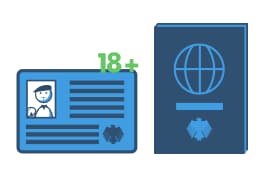
Identity verification using identity documents is the fastest way to reliably establish a person's identity. Identity documents are relatively forgery-proof, show a photo of the person and also provide all the required information about the holder's address and date of birth. If identification is required to conclude a contract, this can be accomplished with an identity card, passport or an appropriate registration certificate within a short time.
Identity verification using a registration certificate
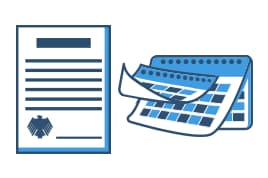
If a contracting party does not have valid identity documents, they can obtain a registration certificate (Meldebescheinigung) from the relevant municipal administration. This certificate contains all the information that is also found on an identity document. It is important that the registration certificate is only valid for a limited period, usually a few months. It should only be seen as a temporary document until the new identity card is available.
Identity verification via the PostIdent procedure
The PostIdent procedure is another form of identity verification. It is used whenever the applicant does not live near the contracting party or the contracting party does not operate a branch network. With a special form, the customer goes to a Deutsche Post branch and presents it there together with their identity documents. The postal employee now checks the information and the authenticity and validity of the identity documents. He then confirms the data for the bank.
Identity verification by notarial certification

If a document must obtain validity through signature and notarial certification, identity verification by the notary is mandatory. This always happens, for example, when a house is bought or sold and the new owner is to receive a notarised deed of ownership. Notaries are also allowed to confirm the authenticity of a person in the same room for a remote conversation partner. For this reason, an identity verification is carried out beforehand, usually using an identity card, passport or registration certificate.
Identity verification with the electronic identity card
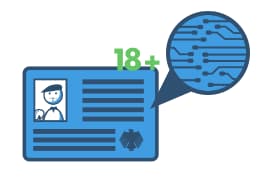
Since November 2010, Germany has been issuing the new electronic identity card (nPA). The personal data printed on this identity document are also stored electronically, in addition to a photo and optionally two fingerprints. Thanks to the built-in RFID chip, various authentications and, for example, digital identity verification are possible with the identity card. With a special card reader it is possible to read the desired data from the identity card and send them to the contracting party via a special app. In addition to identification, numerous portals use this procedure for age verification for FSK 18 content.
Identity verification via video chat

More and more companies are using this method because it is very easy to carry out. Most people today own a laptop with a webcam, which is why identification via video chat is frequently used. In this process, the applicant must establish a connection to the contracting party via a video chat software (for example Skype). Then they must follow the employee's instructions. In most cases the identity card must be placed next to the head so that the photo, address and date of birth are clearly visible.
Is identity verification also possible with a temporary identity card?

From a legal point of view, there is nothing against the identity procedure with a temporary identity card. However, it is understandable that a bank in case of doubt would only conclude contracts that do not extend beyond the validity period of the identity papers. However, if it is about, for example, taking out a supply contract with the local public utilities and it is ensured that the long-term identity card has been applied for, such a contractual relationship can be concluded without problems with a temporary identity card.
It is, of course, also important to know why the identity card was issued only temporarily. Are there perhaps still questions regarding a possible residence permit, or was the identity card simply misplaced and reapplied for? These and other questions help answer the issue.
What should be considered when verifying identity with a passport or identity card without an address entry?

Passports usually do not contain an address. In most cases the bank also requires a registration certificate or identity card in addition in order to fully carry out the identity verification. It is important that the passport and all additional documents are valid.
Citizens with foreign papers can sometimes face a major problem when they want to have an identity verification carried out. For some countries, for example, the place of birth is not recorded. In such cases the PostIdent procedure is not possible because the post employees' software does not allow further processing without entering this information. Verbally asking for the place of birth would contradict the purpose of identity verification. In some cases the PostIdent procedure has even been refused when the place of birth could be proven by other registration documents.
Identity verification abroad
How can I verify my identity abroad?

Situations can arise in which you need to verify your identity abroad. In such a case, it is good to know which authorities are authorised to do this. To have the identity procedure carried out abroad, you can simply visit a bank. In all EU countries, banks are authorised to carry out identity procedures. This is common for account openings, but banks may also determine and certify identity for other purposes.
In addition, all lawyers from all EU countries are able to determine and reliably certify a person's identity. For this you simply need to contact a lawyer in the respective country and present the appropriate documents.
For countries that are not in the EU there is unfortunately no uniform regulation. Applicants should compare whether similar or even better security standards are in place in the respective country. If this is not the case, the identity procedure cannot be carried out with 100% certainty.
Is identity verification possible at the German embassy?
Previously, German citizens living abroad could have an identity verification carried out at the German embassy or consulate located there. This was very practical, for example when a German account was to be opened. In April 2011 a new regulation came into force. From that moment on, German citizens could no longer have an identity verification carried out at an embassy or consulate. Since then, the only alternatives are banks or lawyers, as described above. Also in all other countries outside the EU, embassies and consulates can no longer assist in determining a person's identity. Outside the EU, German emigrants find it particularly difficult to establish or prove their identity. Apart from the PostIdent procedure, no other options are available in this case.

However, there are also countries outside the EU that have a similar level of security and are therefore suitable for identity verification by banks and lawyers. These include:
- Argentina
- Australia
- Brazil
- Hong Kong
- Japan
- Canada
- Mexico
- New Zealand
- The Russian Federation
- Switzerland
- Singapore
- South Africa
- USA
Countries where identity verification is not possible include, for example, Thailand and Turkey. All German expatriates living in Turkey or Thailand must travel to Germany for identity verification and appear in person when opening an account. Alternatively, they can use the PostIdent procedure. This of course not only represents an additional effort for all future account holders who want to open a German account from abroad, but also a financial loss for the banks, whose potential customers are made to struggle with this regulation when trying to set up an account.
However, if the bank has a branch in the emigrant's country of residence, the account can of course also be opened there without problems. This coincidence, however, only occurs rarely.
Our conclusion on identity verification
Are identity verification procedures sensible or rather a waste of time?

Identity verification procedures are of course sensible. They protect banks from major losses and prevent criminal activities in the financial market. This way, banks cannot be misused by money launderers for their shady dealings. The tax authorities also have a strong interest in sound identity procedures. Income and undeclared money can thus not be concealed but must be taxed. For this reason, it is not possible to open an account without undergoing an identity verification.